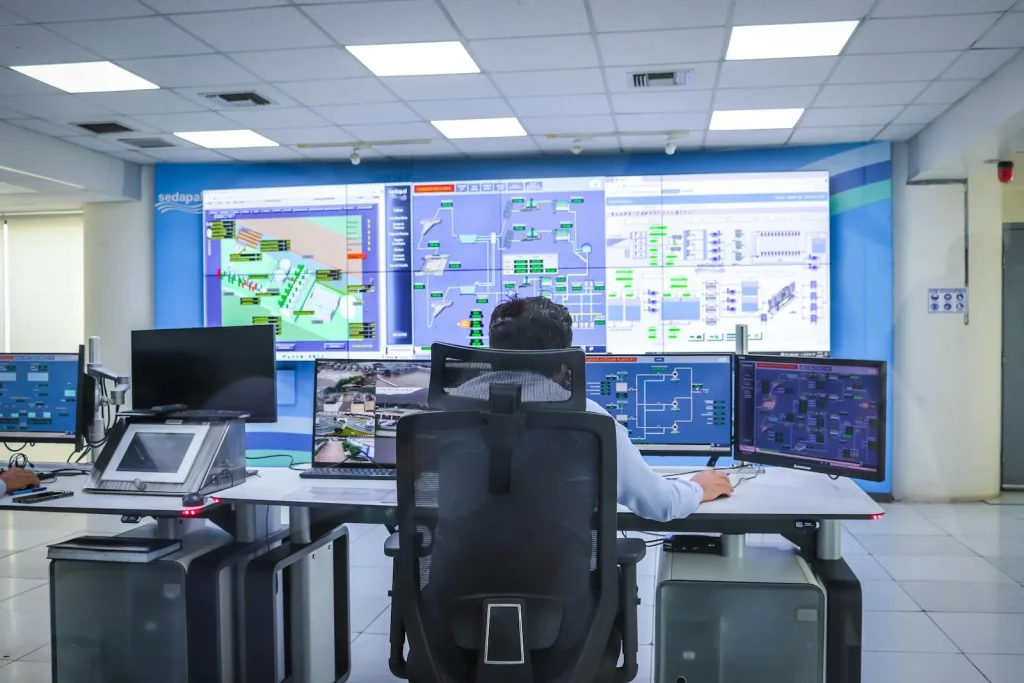
Industrial control systems — PLCs, SCADA networks, and distributed control systems — run power grids, water treatment plants, oil refineries, and manufacturing lines. They were engineered for uptime and reliability, not for defense against nation-state adversaries. With 12,000+ ICS security incidents recorded in 2024 and a 49% increase in state-aligned attacks on operational technology, the gap between how these systems were built and how they are targeted has become a critical risk for critical infrastructure operators. Artificial intelligence is now the primary technology closing that gap — not by replacing industrial protocols, but by learning what normal looks like and detecting when it changes.
- ICS environments face 12,000+ security incidents annually with state-aligned attacks up 49% — traditional signature-based detection cannot keep pace.
- AI-based anomaly detection identifies behavioral deviations in OT protocols (Modbus, DNP3, EtherNet/IP) that rule-based systems miss entirely.
- The OT security market is projected to grow from $27.03B (2025) to $122.22B by 2034 — driven primarily by AI-powered monitoring platforms.
- Only 12.6% of organizations have full visibility across the ICS Cyber Kill Chain — leaving most operators blind to early-stage intrusions.
- Claroty, Dragos, and Nozomi Networks are the three leading AI-powered ICS security platforms with proven deployment in critical infrastructure.
How AI Addresses the Unique Security Challenges of ICS Environments
Industrial control systems were not designed with cybersecurity in mind. Many run on Windows XP-era operating systems that cannot be patched without a full production shutdown. Industrial protocols like Modbus, DNP3, and PROFINET were created in an era when network isolation was the assumed security model — they have no built-in authentication, encryption, or integrity checking. IT/OT network convergence has collapsed that isolation, connecting legacy field devices to corporate networks and, increasingly, cloud management platforms. AI-based security addresses this constraint by operating passively: monitoring traffic without requiring agents on unpatched PLCs or modifications to fragile industrial protocols.
Anomaly Detection in OT Protocols
Traditional ICS security tools rely on signature databases — known-bad patterns matched against traffic. The problem is that ICS attacks increasingly use legitimate protocols and commands to move laterally and execute changes. AI anomaly detection establishes a behavioral baseline of what normal OT communication looks like: which devices talk to which, at what intervals, with what command sets. Deviations from this baseline — a historian polling a PLC it has never queried, a Modbus write command at an unusual frequency, an engineering workstation sending commands outside maintenance windows — trigger alerts that signatures would never catch.
IT/OT Convergence and the Expanded Attack Surface
The convergence of IT and OT networks, accelerated by remote monitoring requirements and cloud-connected SCADA systems, has dramatically expanded the ICS attack surface. A 2025 analysis found that 49% of attacks on ICS environments originated from the corporate IT network — not from direct attacks on OT systems. AI-powered platforms correlate events across both environments: a credential compromise in IT, lateral movement toward the OT segment, and anomalous polling behavior in the control network can be linked into a single kill chain alert that no individual signature rule would surface. The NIST Trustworthy AI in Critical Infrastructure profile specifically addresses this integration challenge, providing a framework for deploying AI systems that must operate across trust boundaries.
Legacy System Constraints and Passive Monitoring
The defining constraint of ICS security is that you cannot deploy security agents on most operational technology. A PLC running a refinery compressor has no spare compute headroom, often runs firmware from 2008, and cannot be taken offline for patching without a planned maintenance window that may be months away. AI-powered ICS security platforms address this by operating exclusively on network traffic — passively listening to all communications between field devices, engineering workstations, historians, and control servers. This passive architecture means the security layer introduces zero risk of disrupting the operational process, which is the non-negotiable requirement for critical infrastructure security tools.
Leading AI-Powered ICS Security Platforms and Deployment Considerations

The operational technology security market has consolidated around a small group of platforms that combine deep OT protocol knowledge with AI-powered anomaly detection. These platforms are not IT security tools adapted for industrial environments — they were purpose-built for OT, with protocol decoders for dozens of industrial standards and asset discovery engines designed for environments where you cannot run active scanning. The OT security market reached $27.03 billion in 2025 and is projected to grow to $122.22 billion by 2034, driven by mandates following attacks on critical infrastructure and by the proven ROI of early-stage detection over incident response costs.
Claroty, Dragos, and Nozomi Networks
Claroty, named a Gartner leader in OT security, provides AI-powered asset visibility and threat detection across IT, OT, and IoT environments. Its platform uses machine learning to build communication baselines for every device on the OT network, then detects behavioral anomalies in real time. Claroty’s integration with enterprise security stacks (SIEM, SOAR, ticketing) addresses the operational challenge of ICS alerts routing to SOC analysts who may lack OT context.
Dragos focuses specifically on industrial threat intelligence combined with OT-native detection. Its platform incorporates threat behaviors from named ICS threat groups — including CHERNOVITE (the group behind the PIPEDREAM/INCONTROLLER malware framework targeting industrial control systems) — and uses this intelligence to tune its AI detection models for sector-specific attack patterns. Dragos’s threat intelligence is particularly relevant for energy and manufacturing operators facing nation-state adversaries.
Nozomi Networks provides OT and IoT security with an AI engine that handles both anomaly detection and vulnerability assessment for industrial assets. Its Vantage platform supports cloud-based deployment, making it accessible for distributed infrastructure operators who need visibility across multiple sites without installing on-premises appliances at every location.
Deployment Architecture and Integration Challenges
Deploying AI-powered ICS security requires solving three integration problems that don’t exist in IT security: passive TAP placement on OT network switches (not all industrial switches support SPAN/mirror ports), protocol coverage (a platform must understand the specific industrial protocols in use, which vary by industry and vendor), and alert routing (ICS anomalies must reach OT engineers, not just IT SOC analysts unfamiliar with process control context). Organizations with full ICS Cyber Kill Chain visibility — only 12.6% of operators according to 2025 research — have typically solved all three. The other 87.4% have partial visibility that leaves early-stage reconnaissance and lateral movement undetected.
Frequently Asked Questions
What is ICS security and why is AI needed?
ICS security protects industrial control systems — PLCs, SCADA, DCS — that run critical infrastructure. AI is needed because legacy OT devices cannot run security agents, and traditional signature-based tools miss behavioral attacks using legitimate industrial protocols.
Can AI security tools disrupt industrial operations?
No — leading ICS security platforms like Claroty, Dragos, and Nozomi operate passively on network traffic and do not interact with field devices, eliminating any risk of disrupting the operational process.
What industrial protocols does AI-based ICS security monitor?
Modern platforms decode Modbus, DNP3, EtherNet/IP, PROFINET, IEC 61850, OPC-UA, and dozens of other OT protocols, building behavioral baselines specific to each protocol’s normal communication patterns.
How does AI detect ICS attacks that use legitimate commands?
AI establishes a behavioral baseline of which devices communicate with which, at what frequency, with what command types. Deviations — unusual write commands, new paths, out-of-window engineering activity — are flagged even when using valid protocol commands.
What percentage of organizations have full ICS Cyber Kill Chain visibility?
Only 12.6% of organizations have full ICS Cyber Kill Chain visibility according to 2025 research, leaving the majority blind to early-stage reconnaissance and lateral movement in their OT networks.
What is the NIST guidance for AI in critical infrastructure?
NIST’s Trustworthy AI in Critical Infrastructure profile provides a framework for deploying AI systems across IT/OT trust boundaries, addressing governance, risk tolerance, and validation requirements specific to industrial environments.